
The SDLC & Your Epic Quest as a Tester
Welcome back! Having explored the 'what' and 'why' of testing, it's time to see where all this action fits into the grand scheme of things. We're talking about the Software Development Lifecycle – or SDLC for short.
Think of the SDLC as the roadmap that guides a software idea from a spark of inspiration to a fully functioning product in users' hands. It might sound a bit formal, but understanding its flow, and more importantly, your vital role within it as a tester, is like getting the keys to the kingdom of quality.
Forget any preconceived notions of testers just waiting at the end; your quest begins much, much earlier!
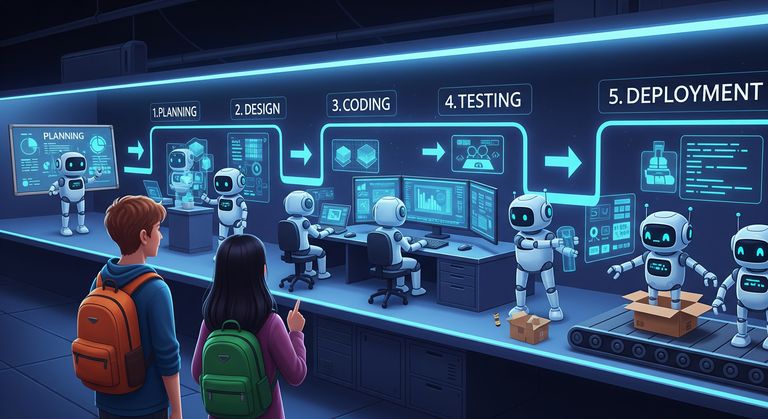
SDLC Models Beyond the Textbook
You'll hear a lot about different SDLC models – Waterfall, V-Model, Agile, Scrum, Kanban, Spiral, and probably a dozen others. Textbooks love to show them as neat, distinct pathways. Waterfall is the classic step-by-step march: requirements, then design, then build, then test (uh-oh!), then deploy. Agile, on the other hand, is all about iterative cycles, collaboration, and responding to change.
Here's a little secret from the trenches: most companies operate on a hybrid model, a unique blend (sometimes a bit Frankensteined!) of these approaches. Imagine a trendy startup building a cutting-edge mobile game. They boast about their super-fast Agile sprints. However, the artwork and character designs are outsourced to a studio that delivers assets on a fixed bi-weekly schedule, more like a mini-Waterfall. The test team quickly learns that 'sprint complete' for code doesn't mean 'art complete.' Their testing has to be flexible, validating core game logic with placeholder art, then re-validating intensively when the final assets drop. It's a hybrid, and recognizing that allows them to plan effectively rather than being constantly surprised.
Why Do Companies Frankenstein Their SDLC Models?
- External dependencies: Vendors or third-party services operate on fixed timelines, forcing teams into mini-Waterfall cycles.
- Legal & regulatory requirements: Industries like healthcare, finance, and aerospace demand heavy documentation, formal approvals, and long validation cycles.
- Large-scale enterprise development: Global teams with thousands of engineers can't function in pure Agile; structured communication and synchronized planning become vital.
- Product nature: Physical hardware development follows a linear path, but embedded software within those products may iterate using Agile.
The Old Way – Testers Waited Until the End
Picture this: developers have been coding away for weeks, maybe months. They've built "The Next Big Thing." Then, often just days before a deadline, this creation is ceremoniously handed over to the QA team. The expectation? "Find all the bugs, quickly!"
This "tester at the end" model, a hallmark of older Waterfall approaches, sounds like a critical checkpoint, but in reality, it's often a recipe for stress and last-minute chaos. It's like being a building inspector who only gets to see the skyscraper after it's fully built. If the foundations are dodgy, what can you realistically do then without massive, costly rework?
When testing is an afterthought, bugs are discovered late, making them exponentially more expensive and complex to fix. It often leads to a blame game – "devs broke it," "QA is too slow." Testers become reluctant gatekeepers, and quality feels like something bolted on at the end, rather than woven in from the start. Imagine the panic on an e-commerce project where, 48 hours before Black Friday, QA discovers users can't actually complete a purchase. That's not a fun place to be, and it highlights why this model is fundamentally flawed for modern, fast-paced development.
The cost isn't just monetary; it's team morale, user trust, and sleepless nights. Nobody wins.
Modern Approach – Quality From Day One
Smart teams figured out that waiting until the end to think about quality is like trying to unbake a cake. Modern development approaches integrate quality considerations and testing activities throughout the entire development lifecycle, not just at the end.
In today's fast-paced development environment, testers are involved from the very beginning of projects. This early involvement transforms the role from reactive bug finder to proactive quality advocate. When testers participate in planning sessions, requirement reviews, and design discussions, they bring a unique perspective that helps teams build better software from the ground up.
This approach recognizes that quality isn't something you test into a product – it's something you build into it from day one. In our next lesson, we'll examine the Shift Left approach in detail, exploring how early testing and proactive quality practices can transform development efficiency and product reliability.
Strategic SDLC Impact of Test Automation
If your path leads to Test Automation, your early involvement takes on even more strategic dimensions. You're not just thinking about how to test; you're architecting the systems that will ensure ongoing quality and enable speed.
Your early contributions often include:
- Strategic Tooling & Framework Decisions: Based on the project's technology stack (e.g., .NET, C#, web, API), you'll help choose suitable automation tools (like Selenium, Playwright, or RestSharp) and design a scalable test framework. Imagine a team building a complex financial application; investing in a robust API automation framework early allows them to validate core calculations and business logic much faster and more reliably than relying only on end-to-end UI tests.
- Designing for Automation: You'll work closely with developers to ensure the application is built with automation in mind. This could mean advocating for clear API contracts, consistent UI element identifiers, or mechanisms to easily manage test data and application state.
- CI/CD Pipeline Integration Strategy: You'll start planning how automated tests will integrate into the Continuous Integration and Continuous Delivery (CI/CD) pipeline, ensuring rapid feedback on every code change.
- Defining the "Automation Safety Net": What critical user journeys, core functionalities, and regression scenarios must be covered by automation to give the team unwavering confidence to release frequently?
An automation engineer is far more than a scriptwriter; she/he is a quality strategist, a process engineer, and a builder of the systems that allow development teams to innovate rapidly without sacrificing stability.
The SDLC Turbocharged
In the world of modern software, particularly with DevOps practices, the SDLC often looks like a high-speed, interconnected loop. You'll hear terms like Continuous Integration (CI), Continuous Delivery (CD), and Continuous Testing. It all aims for one thing: delivering valuable, high-quality software to users frequently, reliably, and sustainably.
And what's the absolute bedrock of this "continuous" philosophy? You guessed it: comprehensive and reliable test automation. Without it, the "continuous" part quickly becomes "continuously breaking things" or "continuously delayed."
Your role here is to ensure this automated quality engine runs smoothly. This involves making sure tests are fast, stable, provide clear feedback, and actually test the right things. When a build fails due to a test in the CI/CD pipeline, you're often on the front lines helping to diagnose whether it's a genuine product bug, a flaky test, or an environment hiccup.
Your Test Suite & Pipeline Are Products!
This is a mindset shift many miss: treat your automation code, your test frameworks, and your CI/CD testing stages as first-class software products. They require good design, clean code, maintainability, version control, and regular refactoring. If your test suite is unreliable or hard to maintain, it loses trust and value. Nurture it, improve it, and be proud of the quality engine you're building!
It's about enabling flow, not just finding flaws.
Key Takeaways
- The SDLC isn't just a chart on a wall; it's the living, breathing process your team uses. Understanding its real quirks and rhythms is your first step to becoming an effective quality advocate.
- Forget waiting until the end! Modern testers, especially automation engineers, jump into the SDLC from day one, asking critical questions, planning for testability, and shaping quality right from the start.
- Your role transforms from a "bug finder" to a collaborative quality champion and architect of confidence, enabling your team to build better software, faster and more reliably.
- In the "continuous everything" world, your automation work is the critical engine that powers safe and speedy delivery, and your test suite itself is a valuable product that deserves top-notch engineering.